
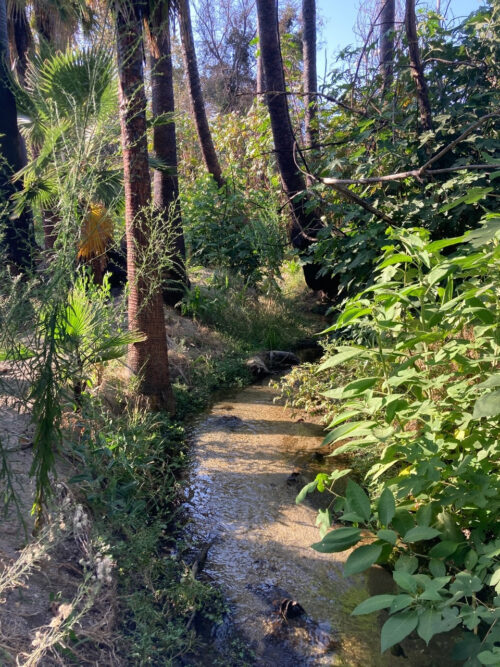
The Draft Environmental Impact Report (DEIR) for the Pasadena/South Pasadena Arroyo Seco Water Reuse Project was released today. The 1300-page document shows a project that is basically the same as the one that the San Pascual Community of Highland Park sued to stop. The community had requested in-depth analysis of the environmental impacts, and a Nature Based Solution Alternative, that included clean-up at the source. All were ignored again. San Pascual site, located between Highland Park and South Pasadena, is a rare riparian Oak/ Sycamore woodland, with a portion on Los Angeles public parkland. It is a cherished ecological and cultural resource featuring mature sycamores, coast live oaks, flowing water, and wildlife. For generations, it has served hikers, runners, birdwatchers, equestrians, and families, and holds deep personal and cultural significance for local residents. San Pascual Park is a key resource in the Arroyo Seco and the LA River Watershed. This project could impact all restoration efforts of our rivers.
Today, the park faces a major threat from proposed plans by the Cities of Pasadena and South Pasadena to construct a water treatment facility within its boundaries. While framed as environmental infrastructure, the project would significantly alter the park and surrounding watershed. It would capture approximately 174 million gallons of Arroyo Seco water annually, returning only about 40% to the Arroyo. The remaining water would be diverted for municipal uses, including irrigation for the South Pasadena Golf Course and Pasadena’s broader water supply, raising concerns about reduced flows in an already stressed watershed.
To build the facility, Pasadena seeks to permanently convert Los Angeles public parkland into industrial infrastructure, raising legal and ethical concerns under the Los Angeles City Charter. Local elected officials, including Council District 14, Ysabel Jurado, have expressed opposition to the project as proposed. Jurado will be introducing a resolution to LA City Council.
Environmental impacts are very significant. The project would remove more than 136 mature trees, eliminating over 82% of the existing canopy and destroying critical habitat for wildlife. Loss of this mature urban forest would increase heat, noise, and pollution impacts on the surrounding neighborhood, which is located within a quarter mile of the 110FWY, while requiring decades to restore ecological function- if at all.
Although proponents propose replanting and redesigning the site, critics argue this would replace a functioning federally designated wetland ecosystem with an engineered landscape centered on infrastructure. The project will be fenced off and inaccessible to the public, who will lose access to their beloved park.
San Pascual Park also holds deep cultural and spiritual significance for the Gabrieleno Band of Mission Indians Kizh Nation, who identify the land as ancestral and sacred. Tribal representatives are strongly opposed to the project and have demanded complete avoidance of the site. Community members also criticize limited outreach, language barriers, and lack of meaningful public engagement.
Opposition is growing among tribal leaders, environmental groups, neighborhood councils, and residents, who argue that alternative water solutions exist that would not require destroying public land or cultural sites.
The effort to protect San Pascual Park is ultimately about preserving public land, honoring Indigenous heritage, protecting biodiversity, and ensuring environmental progress does not come at the cost of irreplaceable ecosystems.
San Pascual Park’s wetland habitat, cultural significance, and public recreational value must be preserved- not sacrificed for industrial infrastructure.
Call to Action
The Save San Pascual Coalition calls on advocates, experts, and community members to support legal review, public engagement, and advocacy efforts. The project is currently in the EIR review process and is accepting public comments. The goal is to preserve San Pascual Park as a living natural sanctuary for future generations- not an industrial facility.
The Save San Pascual Coalition is calling on Sierra Club members, environmental advocates, legal and science experts, and community supporters to help oppose this destructive project through:
- Review of the Draft Environmental Impact Report (DEIR)
- Public opposition letters- Christina Monde Project Manager cmonde@cityofpasadena.net
- Volunteer organizing
- Donations
- Advocacy for sustainable, nature-based alternatives
EIR links
DEIR Volume I 440 pages
https://files.ceqanet.lci.ca.gov/293161-6/attachment/tt-
_vnpfvtpQHmmpKQBrywHgyzTflv3Ow_Jjz82VUHOroVN6vTbM0ylCu4mmzhFLfrap5xKgm
yDh8PuI0
Appendices: 933 pages
https://files.ceqanet.lci.ca.gov/293161-
6/attachment/wFXSoJyrvWI0aybeCfzVrKoTRn3FPtW8ME-vI1Ht2ivlmRTDbQDOsZQTV-
g1br8Z-aBXa5O7dIKAFW9N0
Save San Pascual Park website https://historicgarvanzacoalition.com/
Water Reuse Project website: https://www.cityofpasadena.net/public-works/engineering-and-
construction/construction/arroyo-seco-water-reuse-project/