
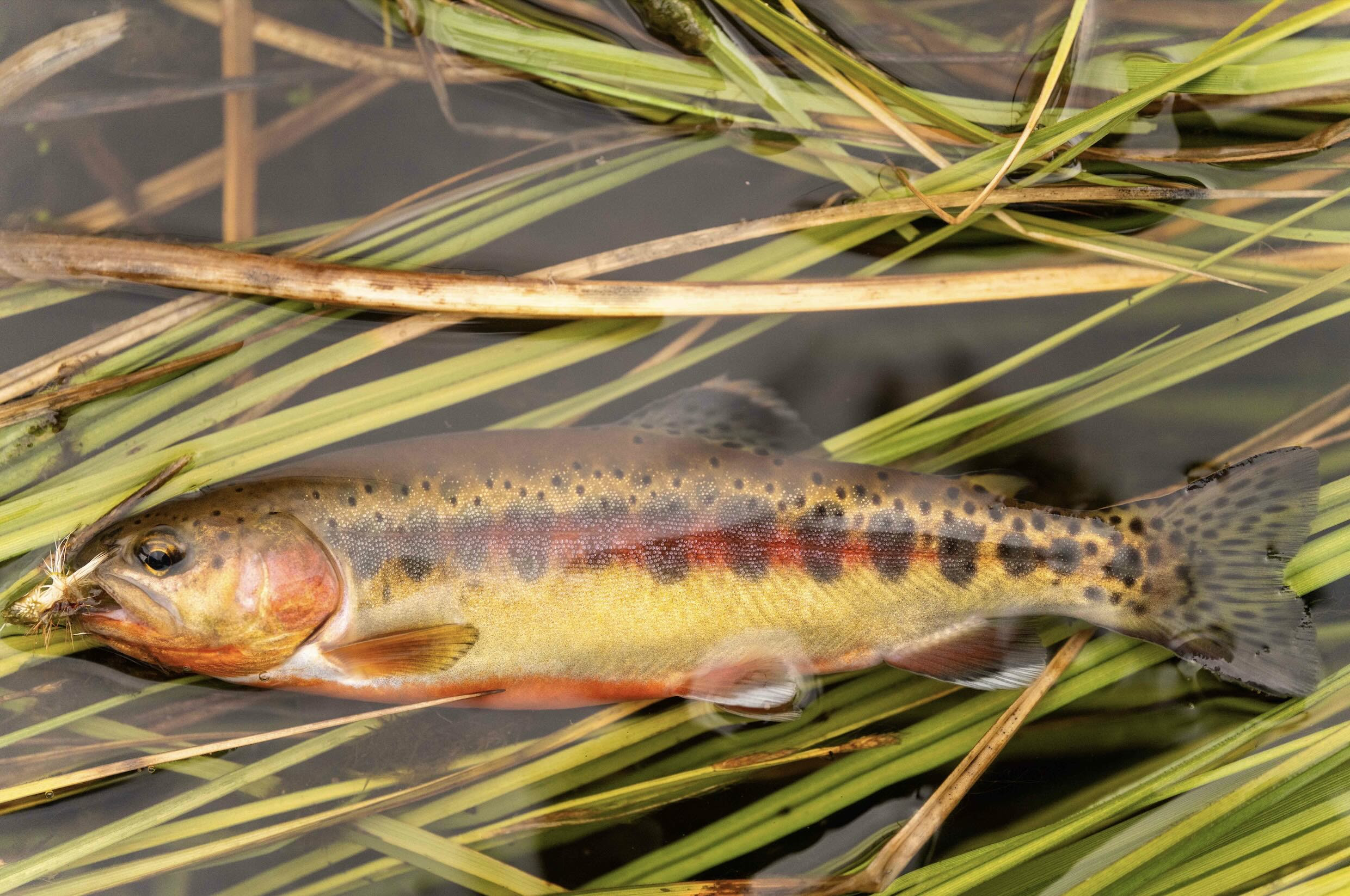
Mountain meadows serve as a key habitat for many inland native trout species across the West. Unfortunately for California’s inland trout populations, some sixty percent of meadow habitat in the Sierra Nevada—home to eight distinct native trout species—is considered impaired.
For the California Golden Trout, whose native range sits above 7,500 feet in elevation and encompasses less than 600 square miles, populations are small fractions of their historic numbers due to compounding threats of hybridization and introgression with non-native rainbow trout, predation by non-native brown trout and habitat degradation. Most degradation of high-elevation meadows derives from legacy uses such as excessive grazing, logging, mining, and off-road vehicle use, which cause meadows to lose much, if not all, of their water storage and habitat function by turning them into a series of gullied streams disconnected from the floodplain.
In mountain ecosystems, healthy meadows act like sponges, storing runoff as groundwater and gradually releasing that water back into streams later in the season when it’s most critical for trout and other aquatic species. By holding cold water on the landscape, healthy meadows act as safe havens for trout against drought, catastrophic wildfire, and rising air temperatures.
Fortunately, meadow ecological and hydrological function can be restored. In the Southern Sierra and elsewhere, TU’s meadow restoration work is proving that degraded conditions can be reversed and meadow systems, and the wildlife that depend on them, can recover. The Golden Trout Meadows Project is a TU and U.S. Forest Service initiative working to advance California Golden Trout recovery by restoring degraded meadow habitat at a landscape scale. In partnership with the Inyo and Sequioa National Forests, California Department of Fish and Wildlife, and a slew of restoration professionals and partner organizations, we’ve embarked on a multi-year effort to restore over 7,000 acres and nearly 75 miles of California Golden Trout streams and meadows.
In bringing ecosystems back to life, we have a powerful and often-overlooked ally in this work: the water itself. To bring degraded meadow streams back to health, we are leaning into a principle and a suite of restoration techniques designed to “let the water do the work.” The Golden Trout Project is primarily working with Low-Tech Process-Based Restoration (LTPBR) techniques. TU staff and partners install large-woody debris jams and sedge mats and build handmade structures mimicking beaver dams. These structures restore the natural function of meadows by slowing water as it runs through the gullied stream channels. Slowing the movement of water through the meadow reconnects the stream channel to the floodplain and increases water storage on the landscape. These interventions expand instream trout habitat by creating more deep pools and increase late season flows, thereby stabilizing water temperatures throughout the year by providing cooler water in summer and pockets of warmer water during winter.
To ensure the long-term project success, we must consider that approximately 90% of California Golden Trout native range is located within public lands, largely U.S. Forest Service. Public lands are often multi-use, working landscapes and California’s Golden Trout territory is no exception. User groups such as grazing permittees, off-highway vehicle users, anglers, and hikers all care deeply about the Sierra high country, but often for different reasons.
However, everybody wins if meadow systems provide their natural scenic and ecological function.
By Greg Fitz and Jessica Strickland, Trout Unlimited.
Jessica is the CA Inland Trout Program Director for Trout Unlimited and heads up the Golden Trout Project.